Official National Park Service Historic Buildings Guide
Historic Structures on the Tennessee Side of the Smokies
John Oliver Cabin - Cades Cove
The John Oliver Cabin is believed to be the oldest preserved structure in Great Smoky Mountains National Park. Built in the early 1820s, the cabin belonged to John and Lucretia Oliver, among the first permanent European settlers in Cades Cove.
One fascinating detail is that the cabin was constructed without nails. The logs were carefully notched and fitted together using traditional Appalachian building techniques.
Located along the Cades Cove Loop Road near Townsend, Tennessee. The cabin is an easy roadside stop with a short walk from the parking area.
More about historic structures in Cades Cove
Cable Mill Historic Area - Cades Cove
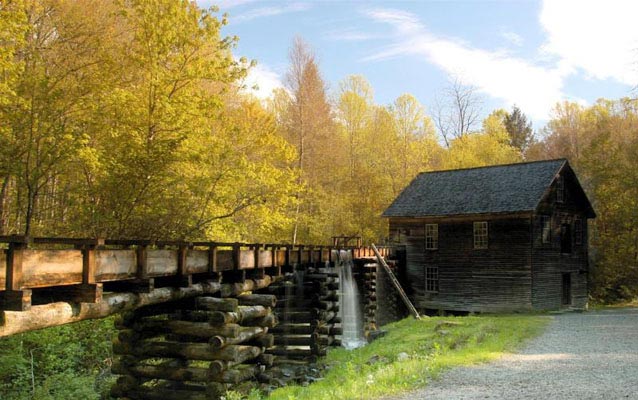
Cable Mill is one of the most photographed historic structures in the Smokies. Built around 1870 by John P. Cable, the water-powered gristmill once served the farming community of Cades Cove.

Unlike many historic structures that are simply preserved, Cable Mill still operates seasonally for demonstrations. The surrounding area also includes a blacksmith shop, smokehouse, barns, and the Becky Cable House.
Located midway through the Cades Cove Loop Road. Parking is available adjacent to the visitor center and mill area. Paths are mostly flat and accessible.
Walker Sisters Cabin - Little Greenbrier
The Walker Sisters Cabin tells one of the most unique stories in park history. The Walker sisters became famous for continuing to live traditionally on their mountain farm even after Great Smoky Mountains National Park was created.
While most residents left when the park was formed, the sisters were granted a lifetime lease and remained at the homestead until 1964.
The cabin sits in a peaceful wooded setting and remains one of the most atmospheric historic sites in the Smokies.
Park at the Little Greenbrier School or the Metcalf Bottoms area. The cabin requires roughly a 1-mile hike via the Little Brier Gap Trail.
Official NPS Walker Sisters History
Little Greenbrier School
Built in the 1880s, this one-room schoolhouse also served as a church and community gathering place for mountain residents. John Walker and his son helped construct the building using hand-hewn poplar logs.
The school provides an excellent look at how isolated Appalachian communities educated children before modern roads and transportation.
A short, easy walk from the Little Greenbrier parking area near Metcalf Bottoms.
Historic Structures Listing Reference
Historic Structures Along Roaring Fork Motor Nature Trail
Noah “Bud” Ogle Cabin and Farmstead
The Noah “Bud” Ogle Cabin is one of the best-preserved pioneer homesteads in Great Smoky Mountains National Park and serves as the gateway to the Roaring Fork Motor Nature Trail near Gatlinburg, Tennessee.
Built in the late 1800s, the homestead includes the main saddlebag-style cabin, a barn, corn crib, and one of the park’s most unique historic features - a spring-fed mountain water system that provided running water to the cabin decades before indoor plumbing became common in Appalachia.
The Ogle barn is also notable as the last remaining four-pen barn within the national park.
A short self-guided nature trail loops through the homestead and nearby forest, making this one of the easiest and most rewarding historic stops in the Smokies.
Located near the entrance to Roaring Fork Motor Nature Trail off Cherokee Orchard Road in Gatlinburg, Tennessee. Easy access from a roadside parking area with a short walking loop.
Official NPS Roaring Fork Page
More History About the Ogle Cabin
Alfred Reagan Tub Mill
Further along the Roaring Fork Motor Nature Trail, visitors can see the Alfred Reagan Tub Mill, a rare example of a small mountain gristmill powered by flowing creek water.
Unlike larger waterwheel mills such as Mingus Mill or Cable Mill, this compact tub mill used a horizontal turbine-like wheel beneath the structure.
Tub mills were ideal for steep mountain streams where water flowed quickly downhill.
The current structure is a reconstruction based on the original mill once operated by Alfred Reagan in the early 1900s.
Located directly beside the Roaring Fork Motor Nature Trail with pull-off parking nearby.
Official NPS Historic Buildings Guide
Historic Structures in the Greenbrier Area
The Greenbrier entrance to Great Smoky Mountains National Park, located east of Gatlinburg near the Arts & Crafts Community, contains remnants of several former Appalachian settlements.
While many homes disappeared after the park was created, visitors can still find preserved barns, cemeteries, rock walls, chimney remains, and historic structures throughout the area.
John Messer Barn
The John Messer Barn is one of the finest surviving cantilever barns in the Smokies and is listed on the National Register of Historic Places.
Built around 1875, the barn is located along the Porters Creek Trail and represents a classic East Tennessee barn style designed to shelter animals and equipment beneath extended upper lofts.
It is one of the few remaining preserved structures from the former Greenbrier Cove community.
Located approximately 1 mile along the Porters Creek Trail from the Greenbrier entrance area. The hike is relatively easy and follows a historic roadbed.
See More About the Greenbrier Entrance
Official NPS Greenbrier Information
Smoky Mountains Hiking Club Cabin
Near the Messer Barn sits the Smoky Mountains Hiking Club Cabin, constructed between 1934 and 1936 shortly after the national park was established.
The cabin is historically significant because it was built by members of the Smoky Mountains Hiking Club, whose advocacy helped support the creation and preservation of Great Smoky Mountains National Park.
Unlike most preserved pioneer-era structures, this cabin reflects the early conservation movement and recreational history of the Smokies.
Located near the Messer Barn along the Porters Creek Trail in Greenbrier.
Historic Cemeteries and Chimney Remains
Throughout the Greenbrier area, visitors can find old rock walls, chimney remains, and cemeteries that mark former homesteads from the communities that once existed before the creation of the national park.
The Porters Creek Trail is especially known for these remnants, including the Ownby Cemetery and the foundations of long-abandoned mountain homes.
These quiet sites offer a powerful reminder that the Smokies were once home to thriving Appalachian families and farming communities.
Historic Structures on the North Carolina Side of the Smokies
Mingus Mill - Oconaluftee
Located near Cherokee, North Carolina, Mingus Mill is one of the most impressive historic structures in the park.
Built in 1886, the mill used an iron turbine instead of a traditional wooden water wheel, making it one of the most technologically advanced mills in the Smokies at the time.
The three-story mill still stands in its original location and remains one of the best-preserved gristmills in the southern Appalachians.
During warmer months, visitors may see milling demonstrations and learn how cornmeal and flour were produced in mountain communities.
Located just off Newfound Gap Road (US-441), about a half-mile from Oconaluftee Visitor Center near Cherokee, North Carolina.
Mountain Farm Museum - Oconaluftee
The Mountain Farm Museum is a collection of historic log buildings relocated from throughout the Smokies to preserve Appalachian farm life.
The site includes a farmhouse, barn, apple house, smokehouse, springhouse, and working garden areas.
Many visitors overlook this area while driving through the park, but it is one of the best places to understand how self-sufficient mountain families lived before electricity and paved roads reached the region.
Adjacent to Oconaluftee Visitor Center near Cherokee, North Carolina. Flat walking paths and easy accessibility.
Official NPS Historic Buildings Information
Make it a day - see our guide to Newfound Gap Road Scenic Drive, or continue to the Southern Blue Ridge Parkway.
Palmer Chapel - Cataloochee Valley
Built in 1898, Palmer Chapel served the Cataloochee Valley community before the national park existed.
The small white frame church sits in one of the most remote and scenic valleys in the Smokies.
Cataloochee is also famous today for elk viewing, making Palmer Chapel an excellent stop for visitors exploring the North Carolina side of the park.
Reached via a winding mountain road from Maggie Valley, North Carolina. The final approach includes narrow gravel sections and mountain driving conditions.
Tips for Visiting Historic Sites in the Smokies
- Many historic structures are located along scenic drives like Cades Cove Loop Road and Roaring Fork Motor Nature Trail.
- Some sites require short hikes, especially the Walker Sisters Cabin and structures in Cataloochee.
- Most buildings are preserved for viewing only. Please do not climb on structures or enter restricted areas.
- Morning visits often provide the best lighting and fewer crowds.
- Weather and road conditions in the mountains can change quickly, especially in winter.
Experience the History of the Smokies
Exploring the historic structures of Great Smoky Mountains National Park adds an entirely different perspective to a Smokies vacation.
These cabins, mills, churches, and schools preserve the stories of the families who shaped mountain life long before the park became America's most visited national park.
Whether you are visiting Cades Cove, Oconaluftee, Cataloochee, or Greenbrier, taking time to explore these historic places helps connect the natural beauty of the Smokies with the people who once called these mountains home.